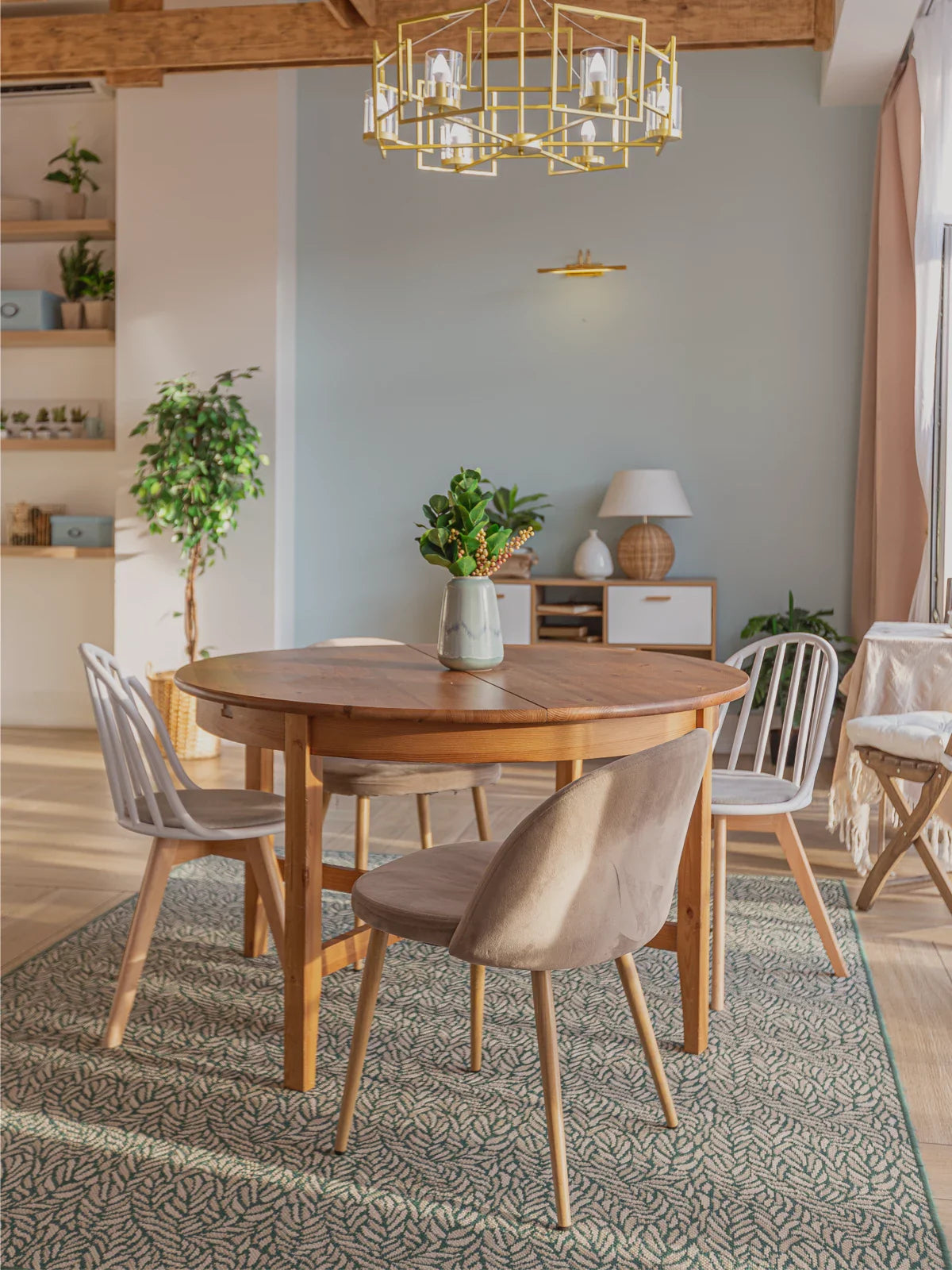
Dining Room Rug Size Guide: The Mechanics of a Perfect Fit
Choosing the right rug size for your dining room is one of the most overlooked decisions in home design, yet it has a profound impact on how the space looks and functions. A rug that's too small can make your dining area feel cramped and disconnected, while an oversized rug may overwhelm the room or create awkward spacing. The key to getting it right is understanding the relationship between your dining table dimensions, the number of chairs, how much space you want chairs to remain on the rug when pulled back, and the overall floor space available. This comprehensive guide walks you through the mechanics of selecting and positioning the perfect dining room rug for your home.
Why Dining Room Rug Size Matters
A dining room rug does more than just define the space visually. It anchors the dining table and chairs as a cohesive unit, protects your flooring from spills and scratches, provides acoustic benefits by absorbing sound, and creates a comfortable surface underfoot when you're seated. The challenge is that dining rooms are high-traffic, high-use spaces where people pull chairs in and out multiple times per day, move around the table, and occasionally spill food or drinks.
Sizing matters because:
- Chairs pulled away from the table should ideally remain on the rug rather than rolling or sitting on bare flooring
- A rug that's too small breaks up the visual unity of your dining zone
- A poorly sized rug can create a tripping hazard or feel unbalanced in the room
- The right size makes cleaning and maintenance much simpler
- Proper rug dimensions protect a larger footprint of flooring from wear and staining
How to Measure Your Dining Table
Before you can determine the right rug size, you need accurate measurements of your dining table. Most dining tables are rectangular, round, square, or oval. Measure the longest and widest points of your table's surface, then note the height from the floor to the tabletop. This information is essential because it helps you calculate how much extra rug space you'll need beyond the table's edges to accommodate pulled-out chairs.
Write down your measurements:
- Table length (for rectangular or oval tables)
- Table width
- Diameter (for round tables)
- Table height
- Chair seat height and depth
If you don't know your table's exact dimensions, most furniture manufacturers provide this information online. Alternatively, you can measure the table yourself using a tape measure. Round to the nearest inch to keep numbers simple.
Understanding Chair Clearance and Rug Extension
The most important principle in dining room rug sizing is that your chairs should remain on the rug even when pulled away from the table. A typical dining chair has a seat depth of 16 to 18 inches (40 to 45 cm). When someone sits down and pulls the chair toward the table, the back legs of the chair move outward. Your rug needs to extend far enough beyond the table edge to accommodate this movement.
As a practical rule:
- For comfortable seating with good chair clearance, extend the rug 24 to 36 inches (60 to 90 cm) beyond all sides of the dining table
- 24 inches (60 cm) is a minimum that works for smaller spaces and tighter dining areas
- 36 inches (90 cm) is ideal for larger rooms and provides a more spacious, balanced look
- Some designers recommend splitting the difference at 30 inches (75 cm) for a moderate approach
This means if your rectangular dining table is 36 inches (90 cm) wide and 60 inches (150 cm) long, and you want 30 inches (75 cm) of clearance on all sides, your ideal rug size would be roughly 4' x 6' (120 x 180 cm). You can use this simple formula: table width plus twice the desired clearance equals rug width; table length plus twice the desired clearance equals rug length.
Rug Sizing by Dining Table Shape
Rectangular Dining Tables
Rectangular tables are the most common, and they pair well with rectangular rugs of the same proportions. To calculate the right size, measure your table's length and width, then add your desired clearance (24 to 36 inches / 60 to 90 cm) on all sides.
Common rectangular dining table and rug combinations:
| Dining Table Size | Seating Capacity | Minimum Rug Size | Ideal Rug Size | Spacious Rug Size |
|---|---|---|---|---|
| 30" x 48" (75 x 120 cm) | 4 seats | 3' x 5' (90 x 150 cm) | 3' x 5' (90 x 150 cm) | 4' x 6' (120 x 180 cm) |
| 36" x 54" (90 x 135 cm) | 4-6 seats | 3' x 5' (90 x 150 cm) | 4' x 6' (120 x 180 cm) | 5' x 7' (150 x 210 cm) |
| 36" x 72" (90 x 180 cm) | 6 seats | 4' x 6' (120 x 180 cm) | 4' x 6' (120 x 180 cm) | 5' x 8' (150 x 240 cm) |
| 42" x 60" (105 x 150 cm) | 6 seats | 4' x 6' (120 x 180 cm) | 5' x 7' (150 x 210 cm) | 6' x 9' (180 x 270 cm) |
| 42" x 84" (105 x 210 cm) | 8 seats | 4' x 6' (120 x 180 cm) | 5' x 8' (150 x 240 cm) | 6' x 9' (180 x 270 cm) |
Round Dining Tables
Round tables work beautifully with round rugs or square rugs positioned at a 45-degree angle. For a round table with a diameter of 36 to 48 inches (90 to 120 cm), a 5' round rug (150 cm) usually works well. For larger round tables measuring 54 to 60 inches (135 to 150 cm) in diameter, a 6' round rug (180 cm) provides appropriate clearance.
The advantage of round rugs is that they offer equal clearance all around the table, which is visually balanced and functional for round tables where guests sit equally spaced.
Square Dining Tables
Square tables pair well with square rugs or round rugs, depending on your design preference. For a 36" to 42" (90 to 105 cm) square table, a 4' x 4' (120 x 120 cm) or 5' round (150 cm) rug generally provides good clearance. Larger square tables at 48" (120 cm) or more may benefit from a 5' x 5' (150 x 150 cm) or even a 6' round (180 cm) rug.
Oval Dining Tables
Oval tables are a hybrid between rectangular and round, offering soft lines with length. Use a rectangular rug with slightly rounded proportions. Measure the table's length and width, then add your desired clearance on all sides using the same formula as rectangular tables.
Rug Sizing for Different Dining Configurations
Four-Seater Dining Tables
A 4-seater table (typically 30" x 48" to 36" x 48") works well with a 3' x 5' (90 x 150 cm) rug in tight spaces or a 4' x 6' (120 x 180 cm) rug if you have more floor space available. The 4' x 6' option provides more generous clearance and makes the dining area feel more intentional.
Six-Seater Dining Tables
A 6-seater table typically measures 36" x 60" to 42" x 72" (90 x 150 cm to 105 x 180 cm). For comfortable seating and chair clearance, a 4' x 6' (120 x 180 cm) rug is a minimum fit, while a 5' x 7' (150 x 210 cm) rug provides more spacious and balanced clearance.
Eight-Seater Dining Tables
Larger tables at 42" x 84" (105 x 210 cm) or beyond ideally need at least a 5' x 8' (150 x 240 cm) or larger rug. However, if your dining room cannot accommodate a rug that large, a 5' x 7' (150 x 210 cm) rug is a workable alternative, though chair clearance will be tighter on the shorter sides.
Rug Placement and Positioning Under Your Dining Table
Once you've selected the right rug size, proper positioning matters. The rug should be centered under your dining table, with equal clearance on all sides. If your dining room has distinct architectural features, you may want to align the rug with doorways, windows, or walls rather than centering it strictly on the table. This creates a more integrated look and helps the dining zone feel like a natural part of your overall room layout.
Key positioning tips:
- Center the rug under the table for a symmetrical, formal look
- Align the rug with adjacent furniture or architectural elements for visual cohesion
- Leave equal space between the rug edge and nearby walls or furniture for balance
- In open-plan spaces, the rug edge can help define the dining zone without creating a cramped feel
- Use a non-slip rug pad underneath to prevent shifting when chairs move
Dining Rugs in Open-Plan and Small Spaces
Open-Plan Living and Dining Areas
In open-plan homes where dining and living areas merge, a dining rug helps visually separate the two zones. The rug doesn't need to be enormous, but it should be large enough that it feels intentional. A 4' x 6' (120 x 180 cm) rug under a 36" x 60" (90 x 150 cm) table clearly delineates the dining space without overwhelming the room. The key is ensuring the rug is positioned to define the dining area without blocking natural traffic flow between zones.
Breakfast Nooks and Small Dining Areas
Smaller dining spaces, such as breakfast nooks or galley-style dining areas, may not accommodate large rugs. In these cases, a 3' x 5' (90 x 150 cm) or even a 3' round (90 cm) rug can work effectively. It won't provide ideal chair clearance, but it still anchors the space visually and protects flooring. In very tight quarters, a smaller rug can still look intentional if it's positioned thoughtfully and paired with other design elements.
Practical Rug Placement Guide
| Placement Consideration | Guideline | Why It Matters |
|---|---|---|
| Clearance Beyond Table Edge | 24-36 inches (60-90 cm) minimum on all sides | Ensures chairs remain on rug when pulled away from table |
| Chair Back Legs on Rug | When seated, back chair legs should be fully on the rug | Provides stability and prevents rolling onto hard flooring |
| Rug Alignment | Center under table or align with room architecture | Creates visual balance and spatial cohesion |
| Distance from Walls | Leave 12-18 inches (30-45 cm) between rug edge and walls | Prevents cramped feeling and allows room to breathe |
| Adjacent Furniture | Rug should not extend under other seating or cabinets | Keeps furniture placement flexible and prevents tripping |
| Rug Pad Usage | Always use a high-quality non-slip rug pad | Prevents shifting when chairs move and protects flooring |
| Traffic Flow | Rug should not obstruct paths in/out of the dining room | Maintains safety and natural movement through the home |
Color, Pattern, and Visual Balance
While sizing is the primary concern, color and pattern also influence how a dining room rug works visually. A lighter rug can make a small dining space feel larger and more open. Darker rugs, conversely, can anchor a large room and create intimacy. Patterns add visual interest and help hide spills, while solid colors create a clean, sophisticated backdrop for your table and decor.
Consider the finishes and colors of your dining table and chairs when selecting a rug. A rug that complements rather than clashes with your furniture creates a unified, intentional look. Geometric patterns can echo the lines of a rectangular table, while abstract or traditional patterns work well with round or oval tables.
Durability and Maintenance in Dining Spaces
Dining room rugs endure more use and risk of staining than rugs in formal living rooms. Choose materials that can handle spills and foot traffic. Wool is durable and naturally stain-resistant. Synthetic fibers offer excellent durability and often come in stain-resistant formulations. Many modern dining rugs are designed to be washable or easy to clean, which is a significant advantage if you have children or frequently entertain guests.
A rug that suits your lifestyle is just as important as one that fits your space. If you prefer low-maintenance options, look for rugs with strong stain resistance and easy cleaning protocols. If you love the look of natural fibers, prioritize rugs with protective treatments that make them suitable for high-use areas.
Common Mistakes to Avoid
- Sizing based only on the tabletop: Many people choose a rug that fits under the table but leaves pulled-out chairs on bare flooring. This defeats the purpose and creates an awkward look.
- Underestimating clearance needs: A 24-inch (60 cm) extension is better than 12 inches (30 cm), which is too small to feel proportionate or functional.
- Ignoring room proportions: A rug that's perfect for the table might look too small if your dining room is large and open.
- Choosing shape that conflicts with table shape: A round rug under a rectangular table can look unintentional. Match rug shape to table shape for visual harmony.
- Forgetting to use a rug pad: Without a non-slip pad, the rug will shift and bunch under foot traffic and chair movement.
- Neglecting the traffic flow: A rug that extends into a doorway or blocks the natural path through the room creates a safety hazard.
How to Calculate Your Ideal Rug Size: A Step-by-Step Formula
Follow this simple process to determine the right rug size for your dining table:
- Measure your dining table's width and length (in inches or centimeters)
- Decide how much clearance you want on all sides (24, 30, or 36 inches / 60, 75, or 90 cm)
- Add twice the clearance amount to both the width and length of your table
- Round to the nearest standard rug dimension
- Choose between rectangular, round, or square rug shapes based on your table shape
Example: You have a rectangular dining table that is 36 inches wide and 60 inches long. You want 30 inches of clearance all around. Add 30 inches twice (once on each side) to both dimensions: 36 + 60 = 96 inches wide for the rug (8 feet / 240 cm) and 60 + 60 = 120 inches long (10 feet / 300 cm). This calculation would suggest a very large rug, but given the maximum available size of 6' x 9' (180 x 270 cm), you would select the largest rug available to maximize chair clearance within practical limits.
FAQ: Dining Room Rug Size Questions
What size rug should I get for a 4-seater dining table?
A 4-seater dining table typically measures 30" x 48" to 36" x 48" (75 x 120 cm to 90 x 120 cm). A 3' x 5' (90 x 150 cm) rug works for tight spaces, while a 4' x 6' (120 x 180 cm) rug offers more comfortable clearance. Choose based on your available floor space and how much distance you want around the table.
Can I use a rug that's too small under my dining table?
Technically, yes, but it won't serve its intended purpose. A rug that doesn't extend far enough beyond the table edge will leave pulled-out chairs on bare flooring, and the space will feel visually disconnected and cramped. A rug sized appropriately for chair clearance creates both functional and aesthetic benefits.
What's the difference between a minimum and an ideal rug size?
A minimum rug size provides the bare necessities: table definition and basic chair clearance (usually around 24 inches / 60 cm beyond the table edge). An ideal rug size offers generous clearance (30 to 36 inches / 75 to 90 cm), making the space feel balanced and providing ample room for pulled-out chairs. Ideal sizing depends on your dining room's overall dimensions and your personal preference for how spacious the area should feel.
Should I choose a round or rectangular rug for my oval dining table?
A rectangular rug is the better choice for an oval table. Measure the table's length and width, then add your desired clearance to both dimensions, just as you would for a rectangular table. A rectangular rug echoes the shape of the table and provides balanced clearance.
How do I prevent my dining rug from shifting when chairs move?
Always use a high-quality non-slip rug pad underneath. Rug pads grip both the rug and the flooring, preventing the rug from bunching or sliding when chairs are pulled in and out or when people walk around the table. Quality rug pads also protect your flooring from the rug's backing.
Is my dining rug too large if it extends into the living room?
It depends on your open-plan layout. If the rug clearly defines the dining area and doesn't block traffic flow, a slight extension into adjacent spaces can work visually. However, the rug should primarily anchor the dining table and chairs, with most of its surface area underneath or immediately around the table rather than spilling into other zones.
Conclusion
Choosing the right dining room rug size is a balance between understanding your table dimensions, accommodating chair movement, and making proportional decisions for your available space. The most common mistakes happen when people size a rug based only on the tabletop itself, forgetting that dining chairs need to sit comfortably on the rug when pulled away from the table. By using the calculations and guidelines in this article, you can confidently select a rug that anchors your dining space, protects your flooring, and looks intentional and balanced in your home. Measure carefully, consider your clearance needs, and remember that a rug sized appropriately for both your table and your room will enhance your dining area for years to come.
Bedroom Rug Size Guide: Crafting a Restorative Sanctuary
Kitchen Runner Size Guide: Ergonomics for the Culinary Workspace
Related Posts

Coastal Rugs: Styles, Colors, and Decorating Guide

Modern Rugs: Styles, Designs & How to Choose

What Is Shabby Chic Rug Style?

Entryway Rug Size Guide: Architecting the Perfect First Impression

Kitchen Runner Size Guide: Ergonomics for the Culinary Workspace

Bedroom Rug Size Guide: Crafting a Restorative Sanctuary