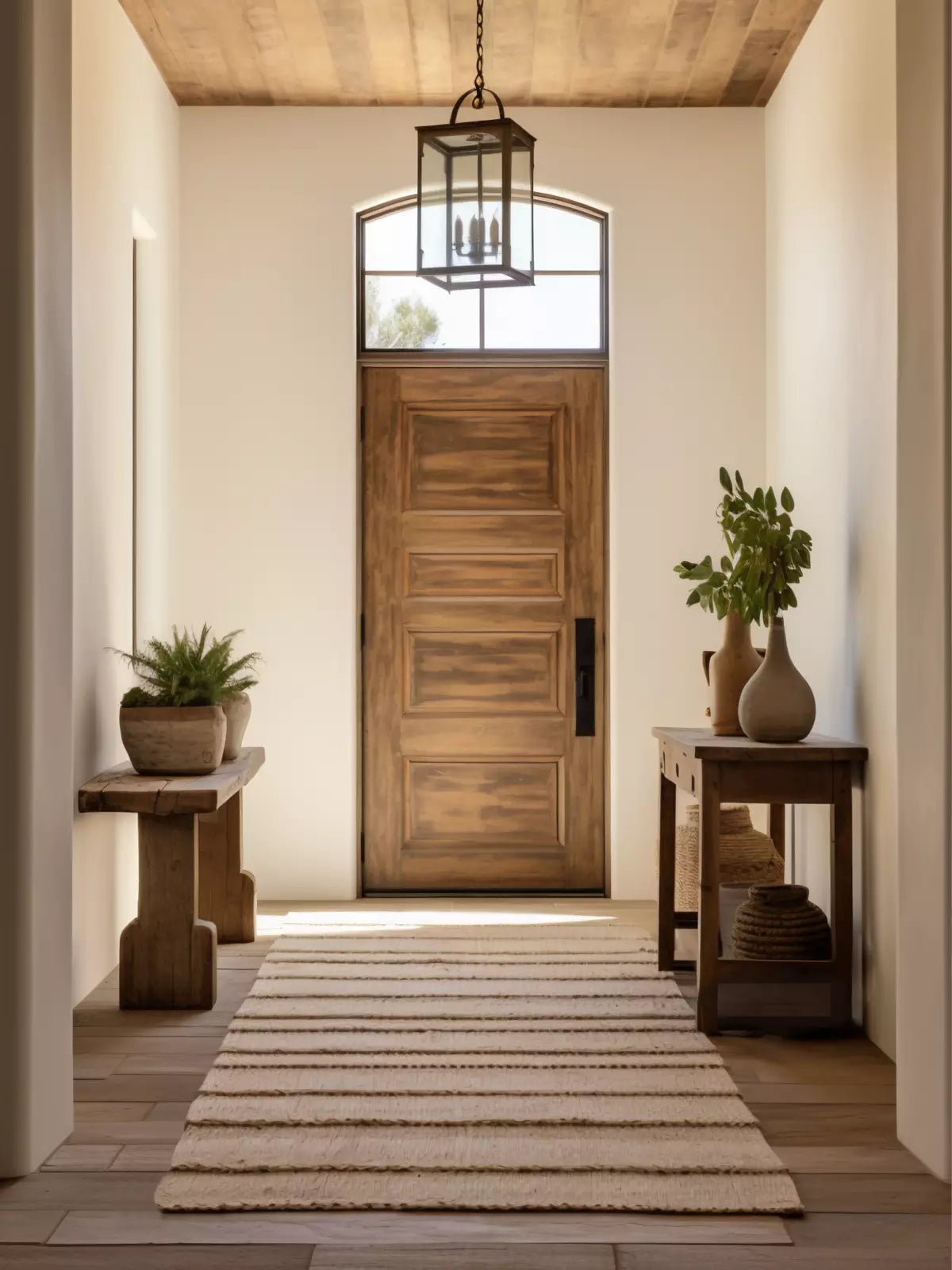
Entryway Rug Size Guide: Architecting the Perfect First Impression
Your entryway is the first impression guests have of your home, and the right rug can transform that space from ordinary to inviting. Choosing an entryway rug size that fits your specific space is one of the most practical decisions you'll make when designing this high-traffic area. A rug that's too small can make an entrance feel disconnected and cramped, while one that's too large can overwhelm the space and interfere with door swing. This guide walks you through measuring your entryway, understanding your layout, and selecting the ideal rug dimensions that balance aesthetics, functionality, and comfort underfoot.
Why Entryway Rug Size Matters
An entryway rug serves multiple functions beyond decoration. It protects your flooring from dirt, moisture, and wear that naturally accumulate near the entrance. It also creates a visual boundary that defines the entryway as a distinct zone within your home. When properly sized, a rug anchors the space and makes it feel intentional and welcoming. When poorly sized, it can create visual clutter or safety hazards like door obstruction and tripping risks.
The right rug size also influences how the entryway feels dimensionally. A correctly proportioned rug makes the space feel balanced and organized, while an undersized rug can make even a generous entryway appear cramped and unfinished.
How to Measure Your Entryway
Before selecting a rug, you need accurate measurements of your entryway. Start by measuring the floor space from wall to wall in both directions. Note the width from one side wall to the other, and the depth from the front door to the back wall or the point where the entryway meets the main living area.
Next, measure the swing path of your front door. Open the door fully and note how far it extends into the entryway. This is critical because your rug should not interfere with the door's movement. If your door swings inward, you'll want to keep rug placement clear of this path. Similarly, note any obstacles like a console table, shoe bench, or side table that might affect rug placement.
Finally, check the thickness of any rug you're considering. Entryways experience high foot traffic, and a very thick rug can create a tripping hazard or prevent a door from opening smoothly. Standard entryway rugs typically have a pile height of 0.5 to 1 inch, which provides comfort without creating clearance issues.
Small Entryway Rugs: Making the Most of Limited Space
Small entryways demand careful rug selection. If your entryway is less than 6 feet wide or 8 feet deep, you're working with a compact space that requires a proportional rug size.
For very small entryways, consider a 2' x 3' (60 x 90 cm) rug positioned directly in front of the door. This size is narrow enough to fit tight spaces without blocking door swing, yet large enough to catch dirt and moisture at the entry point. You can also layer a 2' x 3' (60 x 90 cm) rug with a door mat placed just outside the entrance for additional protection.
Another option for narrow entries is a runner rug. A 2' x 6' runner (60 x 180 cm) runs along the length of your entryway and works well in hallway-style entries or homes with long foyers. Runners are ideal when your entryway is wider than it is deep, as they allow foot traffic to flow without overwhelming the space.
Medium-Sized Entryways: Finding the Balance
If your entryway measures between 6 and 10 feet in width and 8 to 12 feet in depth, you have more flexibility in rug selection. This is the most common entryway size for residential homes.
A 3' x 5' (90 x 150 cm) rug is an excellent choice for medium entryways. This size offers enough visual presence to anchor the space while leaving approximately 1.5 to 2 feet of visible floor on all sides. This breathing room makes the entryway feel open and prevents the rug from dominating the space.
Alternatively, a 2' x 8' runner (60 x 240 cm) works beautifully if your entryway is longer than it is wide. Runners are especially practical in homes where the entry transitions into a hallway, as they can extend the visual flow and protect flooring along the entire passage.
Spacious Entryways: Creating Visual Presence
Larger entryways with generous square footage can accommodate bigger rugs that make a statement. If your entryway exceeds 10 feet in width or 12 feet in depth, you might consider a 4' x 6' (120 x 180 cm) or 5' x 7' (150 x 210 cm) rug.
A 4' x 6' (120 x 180 cm) rug in a spacious entryway creates a clearly defined zone without overwhelming the area. This size leaves approximately 2 to 3 feet of visible flooring, maintaining the sense of openness while making the rug a prominent design feature.
For exceptionally large entryways, a 5' x 7' (150 x 210 cm) or even a 6' x 9' (180 x 270 cm) rug can work, provided your doorways and furniture placement allow for proper clearance. Always prioritize door function and foot traffic flow over rug size.
Rectangular Rugs vs. Runner Rugs for Entryways
Rectangular area rugs and runner rugs serve different purposes in entryway design. Understanding the difference helps you choose the format that fits your space best.
Rectangular Area Rugs
Rectangular entryway rugs work well in square or nearly square entryways and in spaces where you want to create a distinct, grounded focal point. A 3' x 5' (90 x 150 cm) rectangular rug in a centered position instantly makes an entryway feel intentional. Rectangular rugs also pair well with console tables, benches, or other entryway furniture arranged around the perimeter.
Runner Rugs
Runner rugs, typically measuring 2' x 6' (60 x 180 cm) or 2' x 8' (60 x 240 cm), are ideal for narrow, hallway-style entryways or foyers that extend lengthwise. Runners guide foot traffic along a specific path and protect flooring in high-traffic corridors. They also work well in entryways with minimal width, where a rectangular rug might feel awkwardly proportioned.
Positioning Your Entryway Rug: Placement Best Practices
Size alone doesn't guarantee success. How you position your rug matters equally. The ideal placement depends on your specific entry configuration and available furniture.
Centered Placement
For most entryways, centering the rug in the available floor space creates visual balance. Measure equal distance from the left and right walls and position the rug so it's equidistant from each. This approach works especially well in square or evenly proportioned entryways.
Door Swing Clearance
Always position your rug so the front door can swing freely without catching on the edge. A good rule is to keep at least 6 to 12 inches of clear floor between the door swing path and the nearest edge of the rug. If your door swings inward, position the rug away from the swing zone. If it swings outward, you have more flexibility.
Furniture-Anchored Placement
If your entryway includes a console table, bench, or side table, position the rug so that at least two legs of the furniture sit on the rug. This anchors the furniture and the rug as a unified design element. A 3' x 5' (90 x 150 cm) rug positioned with a console table partially on it creates a cohesive, intentional look.
Wall-to-Wall Runners
Runner rugs often look best when positioned to extend from the front door toward the rear of the entryway or down a hallway. A 2' x 8' runner (60 x 240 cm) creates a defined pathway and protects the flooring along the entire route people naturally walk.
Visible Floor Space: Finding the Right Balance
The most successful entryway rugs leave visible flooring on all sides. Aim for 1.5 to 2 feet of bare floor around a 3' x 5' (90 x 150 cm) rug in a medium entryway, or 2 to 3 feet around a 4' x 6' (120 x 180 cm) rug in a larger space. This breathing room prevents the entryway from feeling cramped and maintains visual flow.
The amount of visible floor space you leave around your rug influences how the entryway feels dimensionally. Too little visible flooring, and the space feels overcrowded. Too much, and the rug looks undersized and disconnected.
As a general guide, aim for equal amounts of visible floor on the left and right sides of the rug, and slightly more at the back (the wall opposite the door) than at the front. This subtle asymmetry actually feels more balanced to the eye than perfectly equal spacing.
Door Clearance and Rug Thickness Considerations
Rug thickness plays a practical role in entryway safety and functionality. A plush, thick rug might feel luxurious, but in a high-traffic entry with frequent door opening, it can create problems.
Standard entryway rugs have a pile height between 0.5 and 1 inch. This thickness provides comfort underfoot and excellent dirt-catching ability without creating a tripping hazard or preventing smooth door operation. If you're considering a very thick or sculptural rug, test the door clearance first. The door should open and close smoothly without catching or dragging on the rug.
If your entryway has a threshold or raised edge, confirm that a rug won't cause the door to stick. Some entryways are sensitive to even small height additions, so measuring and testing before committing to a purchase is worthwhile.
How Color, Pattern, and Borders Affect Perceived Proportion
Beyond dimensions, the visual properties of a rug influence how proportional it appears in your space. Understanding these design principles helps you choose a rug that feels right in your entryway.
Light Colors and Subtle Patterns
Light-colored rugs and those with subtle, all-over patterns tend to visually expand a space, making small entryways feel more open. A cream, beige, or pale gray rug in a 2' x 3' (60 x 90 cm) or 2' x 6' runner (60 x 180 cm) can feel less visually heavy than a dark-colored alternative in the same size.
Dark Colors and Bold Patterns
Dark rugs and those with bold geometric or traditional patterns draw the eye and make a strong visual statement. These work exceptionally well in larger entryways where they have room to breathe. In smaller spaces, they can feel visually dominant and potentially cramped.
Borders and Edges
A rug with a defined border creates a sense of intentional boundaries, which many people find visually satisfying. A bordered design can make a 3' x 5' (90 x 150 cm) rug feel more purposeful and decorative. Rugs without borders or with subtle edge details feel more minimalist and contemporary.
High-Traffic Entryway Rugs: Cleaning and Maintenance
Entryways are among the most heavily trafficked areas of any home. Choosing a rug that withstands daily wear and remains easy to clean is essential.
Look for entryway rugs made from durable, stain-resistant fibers like polypropylene or wool blends. These materials resist moisture, dirt, and staining better than delicate fibers. Many modern entryway rugs are treated with protective coatings that repel spills and make vacuuming more effective.
Plan to vacuum your entryway rug at least twice a week to prevent dirt from becoming embedded in the fibers. Use a door mat outside your entrance to capture moisture and debris before they reach the rug. Consider rotating your rug every few months to ensure even wear, especially if your entryway receives heavy foot traffic in a single pattern.
Frequently Asked Questions About Entryway Rug Sizing
What is the standard size for an entryway rug?
There is no single standard size because entryways vary widely in dimensions. However, 3' x 5' (90 x 150 cm) rectangular rugs and 2' x 8' runner (60 x 240 cm) rugs are among the most common sizes for residential entryways. Your ideal size depends on your specific floor measurements and layout.
Can I use a kitchen rug in my entryway?
Yes, kitchen rugs often work well in entryways because they're designed to withstand moisture and heavy traffic. Many kitchen rugs are made from durable, stain-resistant materials that perform exceptionally well in high-traffic entry areas. Look for kitchen rugs in sizes like 2' x 3' (60 x 90 cm) or 2' x 6' runner (60 x 180 cm) to fit typical entryway dimensions.
How much space should I leave around my entryway rug?
Aim for 1.5 to 2 feet of visible flooring around a medium-sized rug in a standard entryway. In larger spaces, leave 2 to 3 feet. The exact amount depends on your entryway's dimensions, but visible floor space on all sides prevents the rug from overwhelming the area and maintains visual flow.
Should my entryway rug be rectangular or a runner?
Choose a rectangular rug if your entryway is roughly square or evenly proportioned and you want a centered focal point. Choose a runner if your entryway is long and narrow, resembles a hallway, or has limited width. Runners also work well in foyers that extend lengthwise.
What rug size works best for a small, narrow entryway?
For small, narrow entryways, a 2' x 3' (60 x 90 cm) rectangular rug or a 2' x 6' runner (60 x 180 cm) typically works best. Both sizes are narrow enough to fit without obstructing door swing while still providing functional dirt-catching coverage at the entry point.
Can rug thickness create problems in my entryway?
Yes. Very thick rugs can create a tripping hazard and may prevent doors from opening smoothly. Choose entryway rugs with a pile height of 0.5 to 1 inch for the best balance of comfort, durability, and safety. Always test door clearance before purchasing a rug.
Conclusion
Selecting the right entryway rug size is a balance between understanding your specific space, considering how the rug will function, and choosing dimensions that feel visually proportional. Start by measuring your entryway width and depth, noting door swing paths and any existing furniture. From there, a 2' x 3' (60 x 90 cm) rug works well in small spaces, a 3' x 5' (90 x 150 cm) suits most medium entryways, and a 4' x 6' (120 x 180 cm) or larger suits spacious entries.
Runner rugs offer an excellent alternative in long, narrow, or hallway-style entryways, with 2' x 6' (60 x 180 cm) and 2' x 8' (60 x 240 cm) being versatile choices. Position your rug to allow free door swing, leave visible flooring on all sides, and choose a durable material suited to high-traffic areas. With these principles in mind, you'll find a rug that transforms your entryway into a welcoming, functional, and visually balanced introduction to your home.
Kitchen Runner Size Guide: Ergonomics for the Culinary Workspace
What Is Shabby Chic Rug Style?
Related Posts

Modern Rugs: Styles, Designs & How to Choose

What Is Shabby Chic Rug Style?

Kitchen Runner Size Guide: Ergonomics for the Culinary Workspace

Dining Room Rug Size Guide: The Mechanics of a Perfect Fit

Bedroom Rug Size Guide: Crafting a Restorative Sanctuary

Hallway Runner Size Guide: Choose the Right Fit